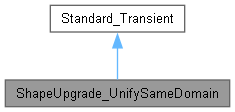
This tool tries to unify faces and edges of the shape which lie on the same geometry. Faces/edges are considering as 'same-domain' if a group of neighbouring faces/edges are lying on coincident surfaces/curves. In this case these faces/edges can be unified into one face/edge. ShapeUpgrade_UnifySameDomain is initialized by a shape and the next optional parameters: UnifyFaces - tries to unify all possible faces UnifyEdges - tries to unify all possible edges ConcatBSplines - if this flag is set to true then all neighbouring edges, which lay on BSpline or Bezier curves with C1 continuity on their common vertices, will be merged into one common edge.
More...
|
| | ShapeUpgrade_UnifySameDomain () |
| | Empty constructor.
|
| | ShapeUpgrade_UnifySameDomain (const TopoDS_Shape &aShape, const bool UnifyEdges=true, const bool UnifyFaces=true, const bool ConcatBSplines=false) |
| | Constructor defining input shape and necessary flags. It does not perform unification.
|
| void | Initialize (const TopoDS_Shape &aShape, const bool UnifyEdges=true, const bool UnifyFaces=true, const bool ConcatBSplines=false) |
| | Initializes with a shape and necessary flags. It does not perform unification. If you intend to nullify the History place holder do it after initialization.
|
| void | AllowInternalEdges (const bool theValue) |
| | Sets the flag defining whether it is allowed to create internal edges inside merged faces in the case of non-manifold topology. Without this flag merging through multi connected edge is forbidden. Default value is false.
|
| void | KeepShape (const TopoDS_Shape &theShape) |
| | Sets the shape for avoid merging of the faces/edges. This shape can be vertex or edge. If the shape is a vertex it forbids merging of connected edges. If the shape is a edge it forbids merging of connected faces. This method can be called several times to keep several shapes.
|
| void | KeepShapes (const NCollection_Map< TopoDS_Shape, TopTools_ShapeMapHasher > &theShapes) |
| | Sets the map of shapes for avoid merging of the faces/edges. It allows passing a ready to use map instead of calling many times the method KeepShape.
|
| void | SetSafeInputMode (bool theValue) |
| | Sets the flag defining the behavior of the algorithm regarding modification of input shape. If this flag is equal to True then the input (original) shape can't be modified during modification process. Default value is true.
|
| void | SetLinearTolerance (const double theValue) |
| | Sets the linear tolerance. It plays the role of chord error when taking decision about merging of shapes. Default value is Precision::Confusion().
|
| void | SetAngularTolerance (const double theValue) |
| | Sets the angular tolerance. If two shapes form a connection angle greater than this value they will not be merged. Default value is Precision::Angular().
|
| void | Build () |
| | Performs unification and builds the resulting shape.
|
| const TopoDS_Shape & | Shape () const |
| | Gives the resulting shape.
|
| const occ::handle< BRepTools_History > & | History () const |
| | Returns the history of the processed shapes.
|
| occ::handle< BRepTools_History > & | History () |
| | Returns the history of the processed shapes.
|
| Public Member Functions inherited from Standard_Transient |
| | Standard_Transient () |
| | Empty constructor.
|
| | Standard_Transient (const Standard_Transient &) |
| | Copy constructor – does nothing.
|
| Standard_Transient & | operator= (const Standard_Transient &) |
| | Assignment operator, needed to avoid copying reference counter.
|
| virtual | ~Standard_Transient ()=default |
| | Destructor must be virtual.
|
| virtual const opencascade::handle< Standard_Type > & | DynamicType () const |
| | Returns a type descriptor about this object.
|
| bool | IsInstance (const opencascade::handle< Standard_Type > &theType) const |
| | Returns a true value if this is an instance of Type.
|
| bool | IsInstance (const char *const theTypeName) const |
| | Returns a true value if this is an instance of TypeName.
|
| bool | IsKind (const opencascade::handle< Standard_Type > &theType) const |
| | Returns true if this is an instance of Type or an instance of any class that inherits from Type. Note that multiple inheritance is not supported by OCCT RTTI mechanism.
|
| bool | IsKind (const char *const theTypeName) const |
| | Returns true if this is an instance of TypeName or an instance of any class that inherits from TypeName. Note that multiple inheritance is not supported by OCCT RTTI mechanism.
|
| Standard_Transient * | This () const |
| | Returns non-const pointer to this object (like const_cast). For protection against creating handle to objects allocated in stack or call from constructor, it will raise exception Standard_ProgramError if reference counter is zero.
|
| int | GetRefCount () const noexcept |
| | Get the reference counter of this object.
|
| void | IncrementRefCounter () noexcept |
| | Increments the reference counter of this object. Uses relaxed memory ordering since incrementing only requires atomicity, not synchronization with other memory operations.
|
| int | DecrementRefCounter () noexcept |
| | Decrements the reference counter of this object; returns the decremented value. Uses release ordering for the decrement to ensure all writes to the object are visible before the count reaches zero. An acquire fence is added only when the count reaches zero, ensuring proper synchronization before deletion. This is more efficient than using acq_rel for every decrement.
|
| virtual void | Delete () const |
| | Memory deallocator for transient classes.
|
|
| void | UnifyFaces () |
| | This method makes if possible a common face from each group of faces lying on coincident surfaces.
|
| void | UnifyEdges () |
| | This method makes if possible a common edge from each group of smothly connected edges, which are common for the same couple of faces.
|
| void | IntUnifyFaces (const TopoDS_Shape &theInpShape, const NCollection_IndexedDataMap< TopoDS_Shape, NCollection_List< TopoDS_Shape >, TopTools_ShapeMapHasher > &theGMapEdgeFaces, const DataMapOfShapeMapOfShape &theGMapFaceShells, const NCollection_Map< TopoDS_Shape, TopTools_ShapeMapHasher > &theFreeBoundMap) |
| bool | MergeEdges (NCollection_Sequence< TopoDS_Shape > &SeqEdges, const NCollection_IndexedDataMap< TopoDS_Shape, NCollection_List< TopoDS_Shape >, TopTools_ShapeMapHasher > &theVFmap, NCollection_Sequence< SubSequenceOfEdges > &SeqOfSubSeqOfEdges, const NCollection_Map< TopoDS_Shape, TopTools_ShapeMapHasher > &NonMergVrt) |
| | Splits the sequence of edges into the sequence of chains.
|
| bool | MergeSeq (NCollection_Sequence< TopoDS_Shape > &SeqEdges, const NCollection_IndexedDataMap< TopoDS_Shape, NCollection_List< TopoDS_Shape >, TopTools_ShapeMapHasher > &theVFmap, const NCollection_Map< TopoDS_Shape, TopTools_ShapeMapHasher > &nonMergVert) |
| | Tries to unify the sequence of edges with the set of another edges which lies on the same geometry.
|
| bool | MergeSubSeq (const NCollection_Sequence< TopoDS_Shape > &theChain, const NCollection_IndexedDataMap< TopoDS_Shape, NCollection_List< TopoDS_Shape >, TopTools_ShapeMapHasher > &theVFmap, TopoDS_Edge &OutEdge) |
| | Merges a sequence of edges into one edge if possible.
|
| void | UnionPCurves (const NCollection_Sequence< TopoDS_Shape > &theChain, TopoDS_Edge &theEdge) |
| | Unifies the pcurve of the chain into one pcurve of the edge.
|
| void | FillHistory () |
| | Fills the history of the modifications during the operation.
|
This tool tries to unify faces and edges of the shape which lie on the same geometry. Faces/edges are considering as 'same-domain' if a group of neighbouring faces/edges are lying on coincident surfaces/curves. In this case these faces/edges can be unified into one face/edge. ShapeUpgrade_UnifySameDomain is initialized by a shape and the next optional parameters: UnifyFaces - tries to unify all possible faces UnifyEdges - tries to unify all possible edges ConcatBSplines - if this flag is set to true then all neighbouring edges, which lay on BSpline or Bezier curves with C1 continuity on their common vertices, will be merged into one common edge.
The input shape can be of any type containing faces or edges - compsolid, solid, shell, wire, compound of any kind of shapes. The algorithm preserves the structure of compsolids, solids, shells and wires. E.g., if two shells have a common edge and the faces sharing this edge lie on the same surface the algorithm will not unify these faces, otherwise the structure of shells would be broken. However, if such faces belong to different compounds of faces they will be unified.
The output result of the tool is the unified shape.
All the modifications of initial shape are recorded during unifying. Methods History are intended to:
- set a place holder for the history of modifications of sub-shapes of the initial shape;
- get the collected history. The algorithm provides a place holder for the history and collects the history by default. To avoid collecting of the history the place holder should be set to null handle.



 1.17.0